(715) 538-1800 [email protected] 36220 Tower Dr, Whitehall, WI 54773, USA
Book Appointment

Periodontal Maintenance in Wisconsin

— protecting the progress you’ve worked hard to achieve

Once gum disease has been treated, ongoing periodontal maintenance helps prevent it from returning. At Whitehall Dental Center, we provide regular maintenance visits—often every three to four months, depending on your needs—to monitor gum health, remove harmful plaque and bacteria, and identify changes before they develop into more serious concerns.

More than a cleaning — a monitoring and prevention program for your gum health

Periodontal maintenance is a specialized clinical hygiene configuration designed explicitly for patients who have completed active therapy for gum disease (like scaling and root planing). It goes significantly deeper than basic cleaning workflows by prioritizing localized subgingival decontamination areas.

Our program coordinates systematic pocket depth checking updates, subgingival biofilm removal, and structural bone grid reviews. This 3-to-4 month treatment frequency is clinically mandated by the rapid 90-day re-colonization cycle of active oral pathogens.

Program Framework Facts

Required Frequency: Every 3–4 Months (Based on pathogen cycles)

Appointment Duration: 60–90 Minutes
Included Metrics: Subgingival debridement, pocket re-probing, stability assessment
Who Needs It: All patients who have completed active periodontal therapy
Clinical Distinctions

Periodontal Maintenance vs. Regular Prophylaxis

Periodontal Maintenance
Routine Prophylaxis (Regular Cleaning)

Why you can't "graduate" back to a regular cleaning

Once you have navigated periodontal disease, your underlying bone frameworks and pocket architectures have permanently altered. Even following successful therapeutic intervention, the specific aggressive pathogens responsible for tissue degradation re-populate deep pocket spaces within 8 to 12 weeks. Specialized maintenance cleanings at 3-to-4 month intervals are the only clinical way we stay permanently ahead of that biological destruction cycle.

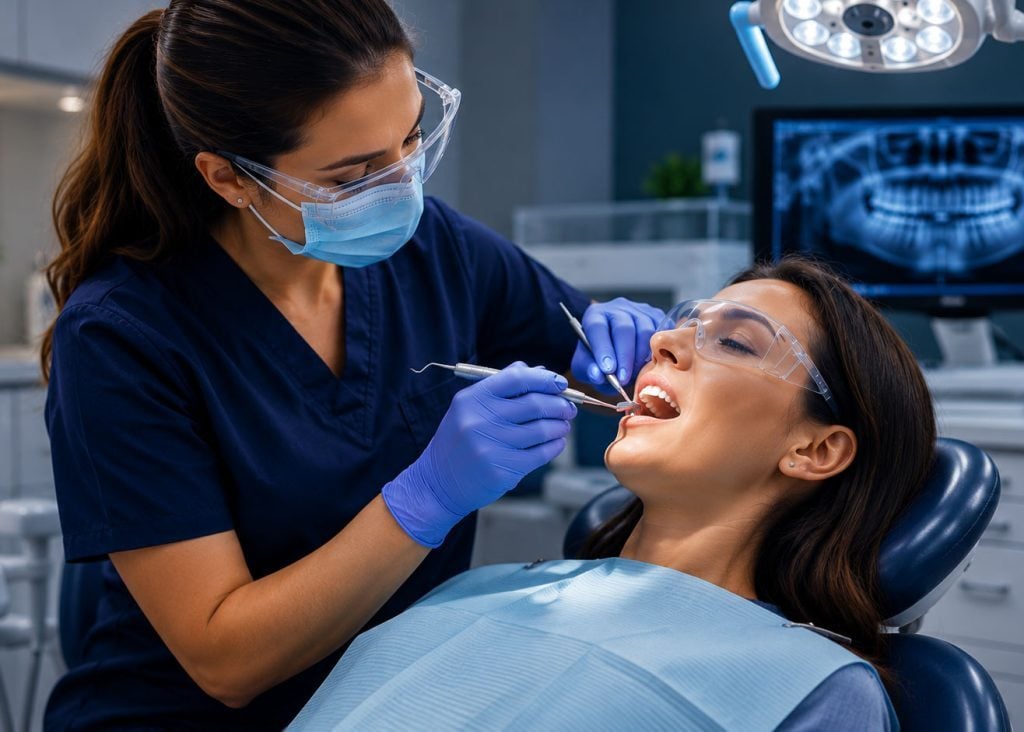
Hygienist carrying out a routine cleaning on a patient
Visit Protocol

What happens at each maintenance care session?

Pocket depth monitoring
We systematically re-probe and log every single pocket matrix. Rising depth metrics flag early warnings of sub-surface disease reactivation, letting us intercept issues at 3 months rather than a long 12-month delay block.
Subgingival debridement
Meticulous mechanical removal of calculus, plaque films, and dense toxic bacterial shelters located far underneath the gum lines — focusing heavily on high-risk, historically damaged teeth spaces.
Disease stability review
Our clinical hygienists formally cross-analyze data points to score your gum state: is it stable, improving nicely, or presenting localized relapse indicators? We recalibrate treatment plans instantly based on raw facts.
Home care alignment
We re-evaluate your home care tools at every single visit block, tracking indicators across interproximal brushes or specialized water jets to help adjust your daily biological management protocols smoothly.

Consistent Care From the Team Who Knows Your History

Complete treatment history on file

We trace your complete history from primary diagnosis right through active therapy loops. Your maintenance sessions build directly on that deep, established knowledge baseline — no starting over with external providers.

Proactive, completely non-reactive

We intervene precisely at the initial biological signals of pocket change — never following extensive structural bone reabsorption. Early maintenance tracking translates into simpler, less invasive, and low-cost corrections.

Automated insurance coordination

Most dental benefits explicitly include periodontal maintenance codes 3–4x annually for qualified histories. Our financial desk automatically cross-checks your provider metrics to verify and maximize your allocations.

Real Patient Feedback

Google reviews

Trusted by local families

4.6 ★★★★★ Google
Jim Maaske
Jim Maaske9 years ago
★★★★★

Always very helpful and informative. They take Ashley's insurance, and they definitely do good work.
curtis murdock
curtis murdock6 years ago
★★★★★

I'm from out of town. I had a dental issue that needed to be taken care of ASAP. I called Dr. Matthews…

Miss Chasity
Miss Chasity6 years ago
★★★★★

Dr. Mattews and his staff always give me the best treatment at his office! They got me in for my routine cleaning…

Troy Kivi
Troy Kivi7 years ago
★★★★★

Had my braces done here, and it turned out great. Very nice office and staff makes me feel like I'm appreciated. Even…

Lisa Otterbacher
Lisa Otterbacher2 years ago
★★★★★

Truly this is one of the best dental offices I’ve ever been to. I moved to the area and had been looking…

Laura Englesby
Laura Englesby6 years ago
★★★★★

My daughter and I have been coming to Matthews Dental for over 15 years. The service as well as their sincerity has…

Erika Layland
Erika Layland9 years ago
★★★★★

Matthews Family Dental is great! My kids have gotten BRACES from Dr. Matthews and their smiles are looking great!

Brian Matthews
Brian Matthews8 years ago
★★★★★

Great team and always a great experience!

Sam Olson
Sam Olson6 years ago
★★★★★

Been going to Dr. Matthews for a few years and will continue going back, despite having to drive over an hour. Tried…

MJ Vang
MJ Vang10 years ago
★★★★★

My husband, our daughter, and I have always came here when we were still residing in Whitehall, WI. Dr. Matthews have always…

Jerome Hamilton
Jerome Hamilton12 years ago
★★★★★

While residing in La Crosse, Wisconsin, my family's dentist was Dr. Jeff Matthews of Matthews Family Dental in Whitehall. Although the drive…

Bonnie Kindschy
Bonnie Kindschy7 years ago
★★★★★

excellent. Helped in a pinch.

Frequently Asked Periodontal Questions

Destructive periodontal pathogens multiply and completely re-colonize treated subgingival pocket spaces within an 8 to 12 week window. Waiting a traditional 6 months allows the bacterial colonies too much un-disrupted time to re-ignite bone reabsorption. A 90-day frequency neutralizes that destruction cycle completely.

For individuals with a verified medical history of moderate-to-severe chronic periodontitis, supportive maintenance remains a lifetime requirement to prevent relapse. However, if your long-term pocket metrics remain remarkably stable over multiple cycles, localized frequency calibrations can be reviewed individually.

Yes. Most premium dental insurance networks explicitly identify the distinct code for periodontal maintenance as a medical necessity for individuals with documented histories of root planing, frequently funding a higher number of annual visits compared to standard cleanings.

Subgingival bacterial biofilms will consolidate and re-trigger tissue destruction cycles within weeks. Patients who routinely drop maintenance frequencies typically encounter silent, pain-free infection relapses that eventually force complex, expensive surgical retreatments downstream.

No. Active deep cleaning (scaling and root planing) is an intensive primary treatment process utilized to eliminate established gum infections. Periodontal maintenance is an ongoing defensive and monitoring security program designed to safeguard those therapeutic results long-term.

Related services

Scaling & root planing

The primary therapeutic deep scaling treatment that periodontal maintenance plans are structured long-term to defend, support, and track.

Gum recession treatment

Tissue alterations or recession lines developing following historical bone drops can be managed via specialized micro-grafting corrections.

Patient home care planning

Maximizing specialized daily hygiene equipment at home is an absolute biological requirement to maintain pocket stabilization metrics between clinical visits.

Open for Appointments

Schedule your visit with our friendly dental team today.